
Thermicra™ · For ADC developers
Your ADC.Subcutaneous.More valuable.
- Early IV spike blunted (expected)
- ↓ CmaxEarly IV spike blunted (expected)
- mg/mL, up to, in one syringe
- 400mg/mL, up to, in one syringe
- Ready to use: no reconstitution
- PFSReady to use: no reconstitution
ADC plasma exposure · IV vs SC
01 — Why SC ADC?
Not a convenience upgrade. A better ADC.
01
ADCs hit a ceiling
Few targets are viable for ADCs, so programs crowd onto the same ones. And changing the linker or payload rarely changes the clinical result enough to stand apart.
02
SC reshapes the PK profile
IV infusion drives an early concentration spike into the toxic range, then a fast fall below it. A Thermicra SC depot is designed to blunt that spike and hold exposure inside the therapeutic window — the basis for better safety and efficacy.
03
A more valuable ADC
Better tolerability and a wider dosing window, delivered from a ready-to-use prefilled syringe, lift the commercial value of an ADC that is already in development.
02 — The exposure
A lower peak. A wider window.
ADC plasma exposure · IV vs SC
IV infusion today
- Sharp early peak (Cmax)
- Narrow therapeutic window
- Higher risk of dose-limiting toxicity
- Little room to adjust the dose
Thermicra SC
- Early burst suppressed, lower Cmax
- Steady exposure in the therapeutic window
- More room to adjust the dose
- Potential for better safety
Observed in animals
<½
The Cmax of the IV infusion, at twice the dose — with the peak moving from minutes to a day (minipig).
~74%
Absolute bioavailability, SC vs IV, from 56 µL at 320 mg/mL (rabbit).
0.14 mL
Carried a high-dose ADC subcutaneously, with dose-dependent exposure (rabbit, interim).
In vitro · comparability to the reference product
Binding and cell killing in two cancer cell lines. The acceptance criterion was met in all four assays.
Reference productThermicra formulation
Binding affinity
Cell line A
- vs. reference
- 98%
- EC50
- Under CDA
Comparable · Pass
Binding affinity
Cell line B
- vs. reference
- 110%
- EC50
- Under CDA
Comparable · Pass
Cytotoxicity
Cell line A
- vs. reference
- 100%
- IC50
- Under CDA
Comparable · Pass
Cytotoxicity
Cell line B
- vs. reference
- 110%
- IC50
- Under CDA
Comparable · Pass
In vivo · pharmacokinetics, SC vs. IV
Single doses in rabbits and minipigs, against the reference product given as an IV infusion.
Reference product · IVThermicra formulation · SC
Total antibody
NZW rabbit
- Absolute bioavailability
- ~74%
Sufficient SC delivery
Total antibody
Yucatan minipig
- Dose-normalized bioavailability
- Under CDA
Preliminary · full study planned
03 — The workflow
From a pharmacy preparation to one injection.
Today · Hospital pharmacy, then the infusion chair
A marketed IV ADC
Lyophilized vial, reconstituted and diluted to a few mg/mL in an infusion bag
- Step 1
Calculate the dose
By body weight, recalculated every cycle
- Step 2
Warm the vials
Bring the vials to room temperature
- Step 3
Reconstitute
Add diluent to each vial and swirl gently — do not shake
- Step 4
Inspect
Check for particles and discoloration before use
- Step 5
Dilute into a bag
Transfer into a saline or dextrose bag; mix gently to avoid foaming
- Step 6
Premedicate
Antipyretics, antihistamines or antiemetics, as the label requires
- Step 7
Infuse
Typically 30 min to 3 h, with the first infusion often slower
- Step 8
Observe and flush
Watch for infusion reactions, then flush the line
- Handled as a hazardous drug during compounding
- IV infusion only — no push or bolus
- Short stability once diluted: use immediately or within 24 h refrigerated
- Pharmacy, nursing and chair time on every dose
With Thermicra · Clinic room or close to home
Thermicra SC prefilled syringe
Up to 400 mg/mL in a ready-to-use prefilled syringe
- Step 1
Take the prefilled syringe
Ready to use — nothing to reconstitute or dilute
- Step 2
Tap or gently shake
A few taps or a gentle shake to mix the formulation
- Step 3
Inject SC by hand
A single subcutaneous bolus — no pump, no IV line
- No compounding step
- No infusion chair or pump
- Fewer preparation errors
- Less workload for care teams
- More convenient for patients
IV steps show the general preparation of marketed IV ADCs supplied as lyophilized vials, with typical ranges; details vary by product. Shown for comparison only.
04 — The cost of care
Fewer steps. A far lower cost of care.
8 → 3
Steps per dose, from pharmacy to patient
0
Oncology compounding steps for an SC dose
100–300
Infusion-chair hours freed per 100 IV doses*
Oncology compounding staff
Cytotoxic doses are prepared by pharmacists in a biosafety cabinet with closed transfer devices and protective equipment. A prefilled syringe needs none of it, so compounding staff, cabinets and consumables go to other work.
Medication errors
Weight-based calculation, reconstitution, dilution and bag handling are each a chance for error. Taking them out of every dose removes the steps where errors happen.
Infusion chair capacity
Hours in the infusion chair become a short injection. The chairs freed up treat more patients each day — or shorten the wait for the next one.
Nursing workload
No IV line to place, no pump to watch through a long infusion, and no post-infusion observation slot to staff. Nurses get their hours back for patient care.
- Fewer steps
- Less staff time
- Free chairs
- More patients treated
- Lower cost per dose
* 100 doses × 1–3 h of infusion and observation, a typical range for marketed IV ADCs; excludes premedication and preparation time. Illustrative — actual savings depend on the product and the site.
05 — Beyond volume
Not just an SC switch. A formulation breakthrough.
Today's SC approaches
Early SC programs lean on hyaluronidase to open the tissue and on-body devices to push large volumes. That manages volume rather than reformulating the drug — an SC switch, but not yet a formulation breakthrough.
From enablingto transforming
With Thermicra
Concentrate the biologic itself: a smaller injection volume, less reliance on bulky on-body devices, and a simpler workflow — true high-concentration, low-volume SC.
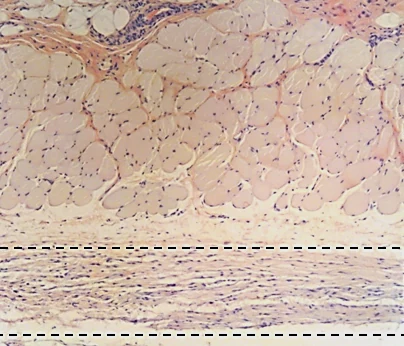
SC with hyaluronidase
Fibroplasia in the subcutis (minimal)
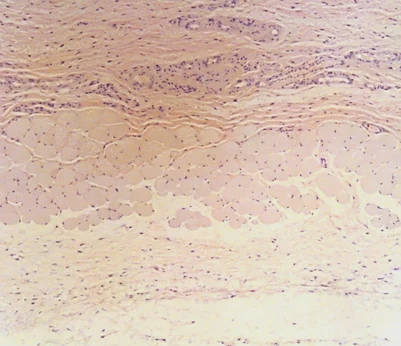
Thermicra SC
No remarkable finding
Proof of concept plus our own aseptic GMP line puts Thermicra first in line for ADC developers moving to SC.
Make your ADC more valuable.
Send us your ADC under an MTA. We'll come back with SC feasibility data on your own molecule.
The exposure chart is an illustrative, expected profile, not measured data. Safety and efficacy depend on the molecule and are confirmed in development.